


Efficiency in warehouse management has consolidated itself as a strategic factor for competitiveness in industrial environments. The need to control inventory in real time, optimize order preparation, and ensure the traceability of logistics operations has driven the adoption of advanced technological solutions. In this context, the Warehouse Management System (WMS) has positioned itself as a fundamental pillar to transform warehouses into intelligent and highly efficient nodes.
This article provides an in-depth analysis of how WMS systems respond to the current demands of the logistics-industrial sector. It will address their key functionalities, operational advantages, integration possibilities with storage systems such as those offered by AR Racking, as well as practical recommendations for implementation. In addition, it will explore their role within the framework of warehouse automation and digitalization.
At AR Racking, we understand that an efficient WMS exponentially enhances the performance of our storage systems. Therefore, our projects incorporate solutions adapted to this technology, ensuring an agile, safe, and connected logistics environment.
Operational Principles of WMS: control, traceability, and efficiency
A Warehouse Management System (WMS) is a digital platform that centralizes and automates all operations carried out within a warehouse. From goods reception to final dispatch, the WMS ensures total control of logistics flows, significantly improving inventory visibility and traceability.
Its operation is based on three key principles:
- Real-time traceability: each load unit, product, or batch is precisely identified and located through scanning technology and data synchronization.
- Process automation: the WMS reduces or eliminates manual tasks through logical rules that determine optimal locations, picking routes, and work assignments.
- Intelligent resource management: it adapts operations according to demand, prioritizing tasks, managing capacities, and balancing workloads to improve overall performance.
Implementing a WMS also reduces operational errors, prevents extra costs from immobilized inventory, and ensures efficiency in complex environments such as those requiring batch control, expiration dates, or load compatibility.
Benefits for the supply chain and inventory management
Adopting a WMS in the industrial environment has a direct impact on key logistics performance indicators (KPIs). Its contribution to inventory management, process control, and operational efficiency translates into measurable improvements:
- Reduction of inventory errors: thanks to automatic updates of movements, inventory accurately reflects available stock, improving decision-making and avoiding stockouts or excess stock.
- Space optimization: the system assigns locations based on rotation, volume, or product characteristics, maximizing the use of warehouse space.
- Increased productivity: the WMS guides operators at every stage, eliminating downtime and unnecessary routes, accelerating order preparation and improving goods turnover.
- Improved customer service: by reducing delivery times and order errors, operational reliability and final customer satisfaction increase.
- Supply chain integration: it connects with ERP systems and transport platforms to provide end-to-end visibility of the logistics cycle.
Ultimately, the WMS transforms the warehouse into a dynamic, proactive, and data-driven environment, enabling agile responses to demand changes, seasonal peaks, or logistical complexity.
Technical Functionalities of a Modern WMS
A next-generation WMS combines management technology, automation, and advanced integration. Among its most notable technical functionalities are:
- Assisted goods reception
- Automated location management (slotting)
- Directed picking (voice, RF, or visual)
- Returns management and quality control
- Automatic replenishment of picking locations
- Batch, serial, or expiration date traceability
- Integration with transport systems (TMS) and ERP
- Real-time dashboards and KPIs
These functions must be adapted to the characteristics of the physical storage system (rack type, product flow, load unit dimensions, etc.), for which AR Racking develops projects fully compatible with WMS solutions at different levels of operational complexity.
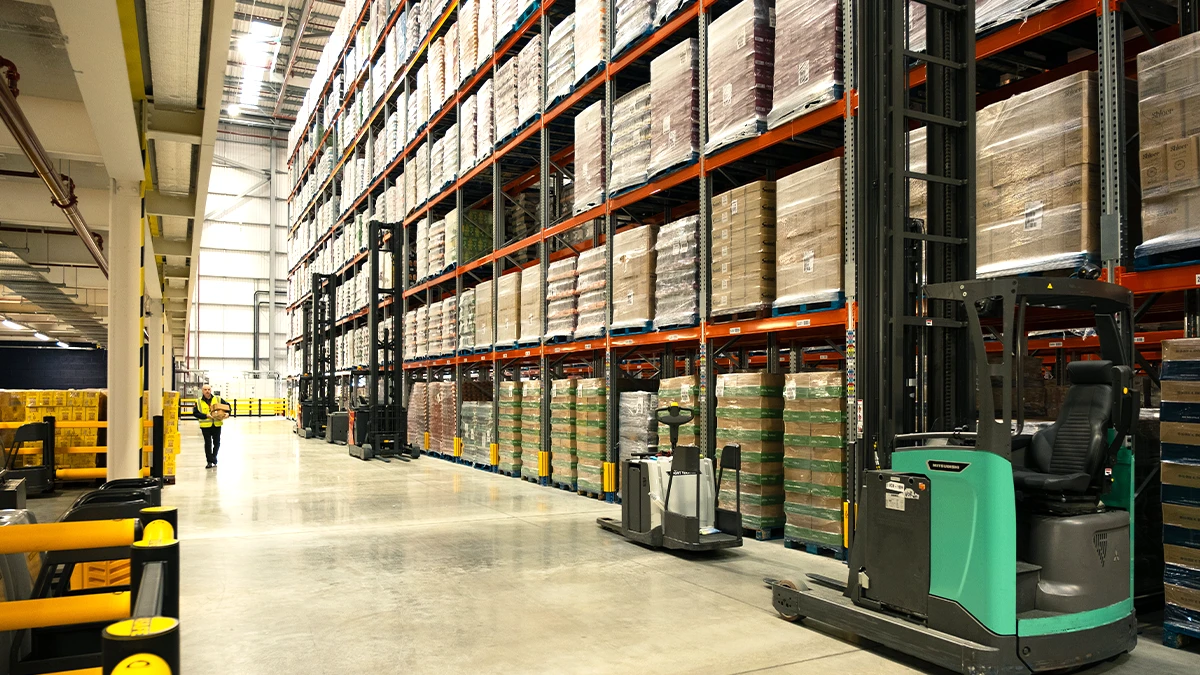
Practical Application of WMS in AR Racking Systems
The benefits of WMS are maximized when integrated with storage systems designed to support the software’s operational logic. At AR Racking, our solutions are designed for seamless integration with WMS platforms, ensuring performance, safety, and scalability.
Some of our compatible systems include:
- Live Storage Pallet Racking (FIFO): ideal for integration with WMS managing expirations or high rotation, leveraging gravity flow to automate movement.
- Drive In/Drive Through Racking: suitable for homogeneous products. The WMS manages the load/unload sequence and optimizes storage density.
- Mobile Pallet Racking: integrable with WMS for automatic aisle opening according to picking orders, maximizing usable space.
- Warehouse with stacker cranes for pallets: the connection between WMS and automated systems ensures continuous, controlled flow with minimal human intervention.
Adapting the physical system to the digital environment is key. Therefore, each AR Racking solution is designed by previously evaluating the WMS requirements that the client will use.
Recommendations for Successful Implementation
To ensure success in adopting a WMS, the project must be approached from a comprehensive, technical, and operational perspective. Some key recommendations:
- Precise initial evaluation: diagnose material flows, product types, and traceability needs.
- Compatibility with the storage system: the WMS must be able to manage the specific rules of location, access, and rotation of the physical system.
- Operator training: technological change must be accompanied by technical training and clear processes.
- Gradual adaptation and pilot testing: phased implementation allows system validation before scaling.
- Technical support and updates: select providers with experience in industrial logistics and post-implementation support.
Proper implementation not only avoids operational disruptions but also generates tangible results in short timeframes.
Adaptation challenges and digital transformation
Despite its advantages, WMS adoption may face challenges that must be anticipated with a clear strategy:
- Resistance to change from operating staff
- Incompatibility between legacy systems (ERP/WMS)
- Underestimation of organizational impact
- Infrastructure limitations (connectivity, hardware, etc.)
To overcome these challenges, it is recommended to:
- Promote leadership committed to digital transformation
- Develop a change management plan
- Establish KPIs and metrics to measure results
- Ensure WMS interoperability with existing systems
The key is to approach WMS not only as a technological solution but as a catalyst for operational change.

Innovation, connectivity, and industry 4.0
The WMS is at the heart of Industry 4.0, acting as a bridge between the physical warehouse and digital logistics control platforms. Its evolution is linked to technologies such as:
- IoT (Internet of Things): connected sensors for product traceability and environmental conditions.
- Big Data and AI: predictive inventory analysis and automated route optimization.
- Cyber-physical systems: integration with AGVs, picking robots, or shuttle systems for fully automated operations.
In addition, within the framework of sustainability, the WMS helps reduce energy consumption, avoid waste, and optimize resources, aligning with current environmental standards.
Conclusion
The WMS has ceased to be an optional tool to become an essential element of modern industrial logistics. Its ability to increase efficiency, improve inventory management, optimize human resources, and facilitate automation makes it a strategic ally for any company operating in highly demanding logistics environments.
At AR Racking, we know that the success of a storage project depends as much on the physical infrastructure as on the management system that supports it. That is why our systems are designed to be fully compatible with the most advanced WMS solutions on the market.
Contact us and our specialized team will guide you in designing and implementing a comprehensive solution that combines a high-performance storage system with the power of a WMS, ensuring efficient, scalable operations adapted to the future of logistics.


