
Select your countryCountry
US

US

Logo
Contact us
Shuttle Pallet Racking
efdw
fwef

Shuttle Pallet Racking

Pallet Shuttle (AR Shuttle) is a compact high-density solution using motorized satellite carts controlled remotely by the operator to move pallets autonomously, optimizing space and operations.


The pallet shuttles are remotely controlled by an operator.


AR Racking is proud member of these national associations:


Hence, there is an optimum use of storage space and workplace accident rates are also reduced.


The use of automated shuttles in place of forklifts during the storage process not only reduces the risk of accidents, but also the maintenance costs resulting from damage of the rack.

Description

This system can work either as FIFO or as LIFO, even in freezer chambers, with temperatures of up to -30°C.

This pallet shuttle system reinforces logistical capacity qualitatively and quantitatively, since it automates the handling of goods on pallets; it is also possible to control the inventory through a system of sensors which count the stored pallets.

Palletized
Palletized or heavy loads
Semi-automatic
Semi-automaticsystem
Suitable for
Suitable forcold storage
5 years warranty
5 years warranty(Structure)

How does Pallet Shuttle Storage Systems work?

The Pallet Shuttle Racking is a compact semi-automated pallet storage solution using self-powered shuttle carts which operate independently to move the pallets in the rack.

Designed for high-turnover storage, this solution enables automatically loading and retrieving pallets continuously by using a remote controlled system.

Unit loads are either placed on the first available location until the rack is fully loaded, or retrieved from their storage locations and moved to the front ready to be picked by a forklift truck, until the rack is fully unloaded.

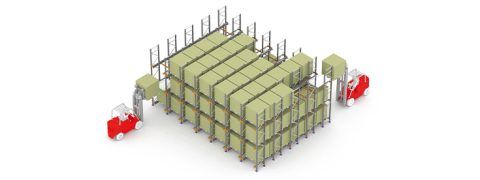
AR Shuttle is positioned in the lane required with a forklift truck. The pallets are stocked one by one by the forklift truck at the beginning of the lane.

The pallet shuttle lifts up the platform and moves it along the channel until it reaches the first free position, where it puts the pallets. Then, it comes back to the beginning of the lane ready for the next drive cycle.

The Pallet Shuttle system enables warehouse operation through both FIFO and LIFO management, with the latter being more common due to only using one of the ends of the aisle for loading and unloading pallets.

For FIFO operation in the Pallet Shuttle Racking System, forklift access must be enabled at the end of the level, therefore allowing access to the unit load located at the back.

This will make it possible to complete the FIFO stock management cycle, and the first pallet to enter the structure will be the first one out. Before putting the last pallets into the lane, AR Shuttle must be removed and put in a new lane.

Advantages of the Shuttle Racking

The main advantages of the AR Racking Inc Pallet Shuttle system are its racking compaction capacity and the increase in productivity and safety in the warehouse.

  • The Pallet Shuttle system enables you to maximize floor space and height available by minimizing the operating aisles needed for trucks.
  • The AR Shuttle system allows for automatic control of inventory by using sensors to count the number of pallets stored.
  • Remote control and bar codes help better control the stock, drastically decreasing error margins.
  • Since forklift operators do not have to enter the aisles, maximum safety is guaranteed when handling pallets, avoiding collisions in the rack structure. This reduces maintenance costs as well as the number of issues from handling loads.
  • With the pallet shuttle system, stored pallets can be loaded and unloaded as FIFO or LIFO, even in freezing chambers up to -30ºC.
  • Optimization of space FIFO / LIFO
  • Enables a continuous handling flow, speeding up operations in the warehouse.
  • Constant handling flow.
  • Powered by a rechargeable lithium battery.
  • Highly safe operation at low maintenance cost.
  • RF controlled.
  • Flexible storage for different types of pallets

Main applications of Warehouse Shuttle Systems

Semi-automated Pallet Shuttle Racking is a system that optimizes space and productivity in the warehouse.

Its main applications are therefore:

  • Warehouses with high loading and unloading activity, and which therefore require high warehouse productivity.
  • Warehouses with a reduced number of product references, but a high volume of pallets.
  • Warehouses with seasonal merchandise, which require fast and flexible operations in specific time periods.
  • Warehouses with cold rooms or freezing chambers, due to the maximum compaction of the space this allows, together with the time saving for the loading and unloading of pallets.
  • Due to its dual FIFO and LIFO management capacity, it can be suitable for warehouses with both perishable and non-perishable products, depending on the chosen configuration.

Components and accessories of the Automated Pallet Shuttle:

The Pallet Shuttle Racking storage system consists of a basic structure of frames and beams with the quality characteristics of all AR Racking’s racking solutions.

This system also has specific components that allow their semi-automatic operation, mainly the shuttles and the rails on which the shuttles move. Safety accessories are also added for the structure and the unit loads.

We divide the main pallet shuttle racking components between the metal structure and the shuttles themselves.

Main components of the Pallet Shuttle Structure:

Galvanized frame

The galvanized frame, as in other storage systems, is one of the basic components of the racking and consists of 2 galvanized uprights or columns, their diagonals, baseplates and floor fixing elements.

Beam

This is a horizontal component that joins the frames together and supports the load. In pallet shuttle racking the rails are supported on the beams and enable the horizontal movement of the shuttles.

The beams are joined to the frame by connectors in the drill holes of the upright.

Rail supports

This is the component that supports the metal rails on which the pallet shuttle moves.

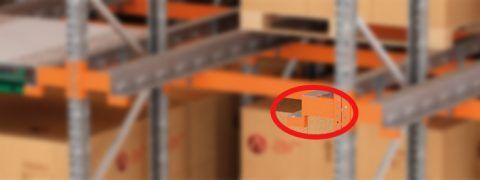
The external supports are anchored to the entry and exit uprights of each aisle, while the internal supports are anchored to the beams.

Shuttle rails

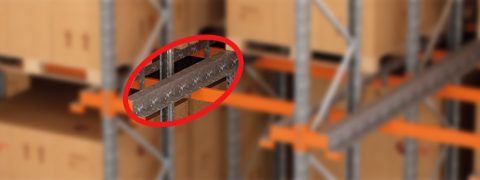
This is the metal component that enables the movement of the pallet shuttle along the aisle. It is supported on the beams and its corresponding supports.

Pallet guidance

It is situated at the start and end of each level, on each side of the lane, to facilitate the task of depositing the unit loads and prevent them from veering from their correct course.

Rail backstop

Component located at the end of the lane, in the unloading area whose purpose is to inform the shuttle of the end of the rail and activate its braking and stopping system.

Other Pallet Shuttle Racking components

Shuttle for pallets

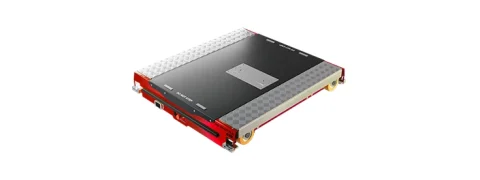
Pallet Shuttle Racking shuttles consist of a base platform equipped with wheels to enable their movement.

A pallet lifting system on the shuttle itself, and a long list of sensors and detection readers that collect information from their environment and implement safety measures.

The shuttle itself is provided with different status indicators, to inform the operator of any possible error, the battery level or whether it is on or off.

Pallet Shuttle remote control

This is the basic control device of Pallet Shuttle Racking which the operator uses to indicate the required operating capacity. It is simple to use with the control buttons and has an information screen.

  • Each remote control unit can control up to 4 pallet shuttles.
  • Pallet count command.
  • Onscreen messages far machine maintenance.

Types of pallets stored by the Shuttle Systems

  • Europallets
  • Industrial pallets
  • Pallets for the chemical industry
  • Pallets for the food industry

In the Pallet Shuttle system pallets can be stored and retrieved according to two different storage orders:

LIFO (Last-in-First-out)

This is the most common system, where the pallets are put in and taken off from the same side.

The lanes should be completely emptied before putting in a new load.

FIFO (First-in-First-out)

This system is ideal for buffering units or transit warehouses, where incoming and outgoing operations are performed from opposite sides.

When the lane is not completely emptied, fast relocates the pallets by bringing them closer to the exit position, allowing new loads to be placed on the rack.

Depending on the required functionality, Shuttle will come equipped with the following elements:

Standard functionality

  • Charging
  • Continuous charging
  • Unloading
  • Continuous unloading
  • Unloading by quantity
  • LIFO pallet compaction
  • Pallet compacting FIFO
  • Pallet counter

Standard equipment

  • On-board lithium battery
  • Battery charger
  • Remote control
  • User manual

Optional equipment

  • Multipallets
  • Spare parts
  • Cold room version

Quality and security of Shuttle Racking

Pallet Shuttle Racking complies with the strictest national safety standards, and also includes AR Racking’s guarantee of excellence.

Five-year quality assurance

The reliability of our pallet racking solutions means we are able to offer 5-year quality guarantees against all types of manufacturing or hidden defects in the components of the main structure of our racking solutions.

100% automated production

The production process of the basic components of our Pallet Shuttle Racking solutions is fully automated in our production centre: state-of-the-art profiling machines with a continuous cutting process and laser measurement control, welding centres and automated painting and packaging processes, which guarantee the highest quality parameters.

Traceability system

Our industrial pallet racking uprights and beams include a pioneering traceability system in the sector. With this system, our storage system components have an identifying mark, which means that each upright and beam can be traced and documented, and that information is therefore available on its design and the raw material used in its manufacture.

Designs developed at the in-house technology center

Our Pallet Shuttle Racking systems are designed and calculated in our exclusive technology centre where our expert technical team allows us to develop projects with diverse and demanding logistics requirements.

Tests at Research and Testing Laboratory

The Research and Testing Laboratory developed in collaboration with a prestigious university allows us to test and analyse our Pallet Shuttle Racking systems; it simulates, calculates and researches the efficacy of the geometries, and makes full structural calculations on the behaviour of systems already installed.

The quality certificates of the Pallet Shuttle Automation are:

  • ISO 9001: 2008
  • ISO 18001: 2004
  • OSHAS 18001: 2007
  • Welding certificate: UNE EN ISO 3834-2: 2006
  • Galvanized steel corrosion resistance certificate: UNE EN ISO 14713-1
  • Galvanized steel reaction to fire: EN 13501-1: 2007
image
image
Shuttle Pallet Racking with low-emission steel

Shuttle Pallet Racking can incorporate AR Racking D-CARB, combining high-density compact storage with a reduction in the carbon footprint associated with the steel structure. This is the product naming currently used on AR Racking’s U.S. pallet-racking range.  

The low-emission steel option does not alter rack capacity, structural calculations, safety or the operation of the powered shuttle.

Each project is supported by a certificate stating the amount of low-emission steel supplied and the CO₂ savings achieved compared with conventional steel.

Speak with our team to evaluate AR Racking D-CARB for your Shuttle Pallet Racking project.


Frequently asked questions about Shuttle Pallet Racking

The AR Shuttle is a compact semi-automated pallet storage system that uses motorized satellite vehicles to transport, deposit, and retrieve pallets autonomously within the storage channels. The operator places the satellite vehicle and the load at the channel entry using a forklift, then uses a radio-control handset to instruct the vehicle to carry out loading, unloading, or compaction operations. This reduces the need for the forklift to enter the racking structure and improves overall storage density.

Unlike drive-in rack, in the AR Shuttle system the forklift does not enter the internal aisles of the structure — the satellite vehicle handles all pallet movement within the channels. This significantly reduces the risk of impacts and structural damage. The system also allows a different load to be stored on each level, and can improve operational throughput by overlapping satellite and forklift movements during consecutive loading or unloading tasks.

Yes. The AR Shuttle can be configured for LIFO operation, with loading and unloading from the same face, or for FIFO operation, with loading and unloading from opposite ends of the channel. The chosen configuration is defined during the project design phase based on the operational requirements and the rotation logic applicable to each product line.

This flexibility makes the system suitable for a wide range of applications, from cold storage facilitys with strict rotation requirements to ambient distribution with variable SKU turnover. 

The pallet shuttle system AR Shuttle is particularly well suited to cold storage facilitys and freezer environments because of its high compaction, which reduces the refrigerated volume and improves energy efficiency. The satellite vehicle is designed to operate reliably at low temperatures, including in deep-freeze conditions.

Reducing the time that operators spend working inside the cold storage facility is an additional benefit, as the forklift only needs to access the aisle entry rather than traveling deep into the structure.

Under normal operating conditions, the satellite will not start a mission if the battery level is below the defined minimum safety threshold. However, in the unlikely event of a battery failure during operation, the vehicle is designed to hold its position safely within the channel. A rescue procedure using the forklift can then retrieve the satellite.

The lithium battery management system continuously monitors charge levels and provides alerts to the operator before the threshold is reached.

A single operator can manage several satellite vehicles from the radio-control handset, with a standard configuration allowing control of up to three units. This enables efficient use of the operator’s time, particularly in large installations where multiple channels are being loaded or unloaded simultaneously.

The AR Shuttle incorporates safety systems designed to protect both the operation and personnel. These include end-of-channel detection sensors to prevent the vehicle from traveling beyond the channel limits; anti-collision detection; battery level monitoring with low-charge warnings; and position feedback to the control handset. The system is also designed to hold its load safely in the event of a power interruption.

The AR Shuttle can coexist with a WMS-managed warehouse, but the satellite handset operates independently from the warehouse management software. The operator receives task instructions from the WMS in the usual way, and then uses the handset to direct the satellite vehicle accordingly.

For fully integrated automation — where the satellite movements are controlled directly by the WMS or a WCS — a higher level of system integration is required, which should be assessed during the project design phase.

Each AR Shuttle unit is designed to handle loads of up to 1,500 kg as standard, with versions available for loads up to 2,000 kg depending on the project specification. Travel speed within the channel is optimized to balance throughput with safe and controlled pallet movement.

AR Racking defines the appropriate satellite model and channel parameters during the engineering phase to ensure performance targets are met.

An existing drive-in installation cannot be directly converted to an AR Shuttle system without a thorough structural and dimensional review. The two systems have different structural requirements, rail profiles, and clearance tolerances.

In some cases, a partial reuse of existing structural elements may be possible, but this must be assessed on a project-specific basis by AR Racking’s engineering team.

The AR Shuttle is a semi-automated system, not a fully automated solution. Its level of automation is limited to the movement of the satellite vehicle within the channels; the forklift and operator are still required for channel entry, satellite repositioning, and all interface tasks.

However, the system can be a stepping stone towards greater automation. With the appropriate structural design and layout planning from the outset, it is possible to evolve the installation towards higher levels of automation.

The AR Shuttle is available in a wide range of sizes and can be adapted to suit different pallet dimensions. The critical requirement is that pallet dimensions and tolerances are clearly defined during the project design phase, so that the channel geometry, rail spacing, and satellite model are correctly specified.

Pallets with irregular or poorly conditioned bases may cause handling issues and should be assessed individually.

There is no single depth limit defined solely by the satellite vehicle. Channel depth is determined by the height of the building, the number of pallet positions required, the load weight, the forklift reach, and the operational requirements of the project.

AR Racking designs channel depth and height as part of the overall project layout to balance density, throughput, and operational efficiency.

The AR Shuttle’s lithium battery reaches full charge in approximately six hours and provides up to eight hours of operational autonomy under typical working conditions. For continuous operations, it is advisable to have a spare battery available so that the satellite can return to service immediately after recharging.

The battery management system monitors charge levels in real time and alerts the operator when charging is needed, preventing unplanned downtime.

Before defining an AR Shuttle project, AR Racking analyzes the client’s operational requirements in detail: unit load type and dimensions, number of SKUs, rotation frequency, daily throughput targets, building dimensions, and any specific environmental or temperature requirements. This analysis is used to define the optimal number of satellites, channel depth and height, layout configuration, and the most appropriate FIFO or LIFO logic for each product zone.

AR Shuttle installation is planned in a modular way, and where the warehouse layout and operational activity allow, phased installation is possible to minimise disruption. Zones can be commissioned progressively while other areas of the warehouse remain operational.

AR Racking’s project management team works with the client to plan the installation sequence and minimise downtime during the transition period.

As part of the project handover, AR Racking or its accredited partners can provide on-site training to operators and maintenance personnel. Training typically covers radio-control operation, mission programming, battery management, basic troubleshooting, and safety procedures.

The system is designed to be intuitive to operate, and most operators reach proficiency within a short familiarisation period.

The AR Shuttle control handset displays operational information including battery status, mission status, position within the channel, and basic fault alerts. This allows the operator to monitor the vehicle’s condition and identify any issues during normal operation.

For more advanced monitoring and integration with warehouse IT systems, additional diagnostic tools and data interfaces can be specified as part of the project scope.

The AR Shuttle does not impose floor requirements beyond those of other conventional storage systems. The structural tolerances for the racking are calculated in accordance with ANSI/RMI MH16.1 (or the equivalent international standard EN 15512), and the rail installation for the satellite vehicle is specified to ensure accurate and reliable movement within the channels.

The satellite vehicle requires preventive maintenance of its critical components, including sensor cleaning, battery and charging system checks, wheel and drive mechanism inspection, and verification of the electronic control systems. The maintenance schedule is defined by AR Racking and should be followed to ensure reliable long-term performance.

The ROI for an AR Shuttle project is calculated primarily on the basis of operational savings and performance improvements compared with the previous storage solution. Key factors include the increase in storage capacity per square metre, the reduction in forklift movements and operator time, energy savings (particularly in cold storage facility applications), and the reduction in product damage.

AR Racking can provide a project-specific ROI analysis during the pre-sales phase, using the client’s operational data to model the expected benefits.